GEOTECHNICALENGINEERING1
STOCKTON
HomeSeismicBase isolation seismic design

Base Isolation Seismic Design in Stockton: Protecting Structures Against Delta Ground Motion

Geotechnical engineering with regional judgment.

LEARN MORE

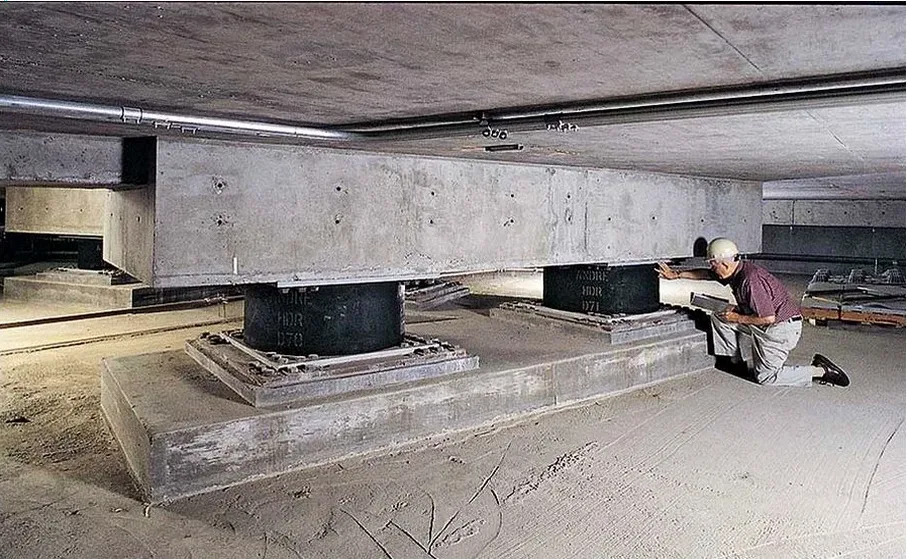
Too many engineering firms in the Central Valley treat Stockton’s seismic profile like it’s just another inland California city. That assumption leads to under-designed foundations and isolation systems that can’t handle the real hazard: deep, soft basin soils amplifying long-period motion. The Sacramento–San Joaquin Delta deposits beneath Stockton, extending over 100 feet in many areas near the Deep Water Channel, create a resonance problem for mid-rise and tall structures. We see projects where a standard fixed-base design meets code on paper but ignores the spectral displacement demand that a site-specific hazard analysis reveals. Our base isolation seismic design workflow starts with that site-specific ground motion characterization, then selects and models elastomeric or sliding isolation systems to decouple the structure from the amplified ground shaking. The result is a design that keeps drift ratios in check and protects non-structural components that would otherwise fail during a major event on the nearby San Andreas or Hayward faults.

Isolating a structure on 100 feet of Delta mud isn't just about picking a bearing—it's about understanding how the basin amplifies motion at the very period your isolation system creates.
Our service areas

How we work

The geotechnical contrast between Stockton’s established neighborhoods illustrates why isolation parameters must be calibrated block by block. In the Brookside area, near the Calaveras River, you encounter loose sands and soft clays that can liquefy under a design-level event, demanding isolation bearings with high lateral displacement capacity and solid moat wall detailing. Further south, around Weston Ranch, the soils transition to stiffer, older alluvial deposits where the dominant hazard shifts from excessive displacement to higher spectral accelerations at shorter periods. A one-size-fits-all isolation design fails in both contexts. We run nonlinear time-history analyses using ground motions matched to the uniform hazard spectrum for each site, verifying that the isolation system period—typically 2.5 to 3.5 seconds for lead-rubber bearings—stays well above the predominant site period. For projects requiring deeper soil characterization before isolation design, we coordinate with a CPT test program to map shear wave velocity profiles without disturbing the sensitive Delta clays, ensuring the site classification per ASCE 7-16 Chapter 20 is based on measured data, not just regional proxies.
Base Isolation Seismic Design in Stockton: Protecting Structures Against Delta Ground Motion
Technical reference — Stockton

Local geotechnical context

One pattern we observe repeatedly in Stockton is the misapplication of simplified equivalent lateral force procedures for isolation design on Site Class D and E soils. The code permits it under strict conditions, but the deep basin effects here routinely push the fundamental site period into the 0.8 to 1.5 second range, right where the isolation system’s effective period would be. That overlap amplifies demand rather than reducing it. We’ve reviewed projects where this was missed at the schematic design phase, requiring expensive reanalysis and bearing redesign after construction documents were already underway. The practical observation is this: if your borings show more than 80 feet of Holocene alluvium before reaching competent material, the isolation system needs a response-history analysis, not a static coefficient approach. The IBC and ASCE 7 mandatory provisions for isolated structures on soft sites exist precisely because of basins like the one beneath Stockton.

Need a geotechnical assessment?

Reply within 24h.

Email: info@geotechnicalengineering1.com

Regulatory framework

ASCE/SEI 7-16 — Minimum Design Loads and Associated Criteria for Buildings and Other Structures, Chapter 17, IBC 2021 — International Building Code, Section 1604 and Chapter 18 Soils and Foundations, ASCE/SEI 41-17 — Seismic Evaluation and Retrofit of Existing Buildings (for isolation retrofit projects), AASHTO Guide Specifications for Seismic Isolation Design (when applicable to bridge structures in the region)

Technical parameters

ParameterTypical value
Design spectral acceleration (SDS, Site Class D, 2% in 50 years)1.15g – 1.45g (site-dependent)
Design spectral acceleration (SD1, Site Class D, 2% in 50 years)0.55g – 0.75g (site-dependent)
Effective isolation period (lead-rubber bearing)2.5 s – 3.5 s
Effective damping ratio (isolated mode)15% – 30% equivalent viscous damping
Maximum considered earthquake (MCE) displacement18 in – 32 in (soft site conditions)
Bearing vertical load capacity500 kips – 3,000 kips per isolator
Applicable analysis method per ASCE 7-16 §17.5Response-history analysis required for Site Class D/E with S1 ≥ 0.50g

Frequently asked questions

What is the typical cost range for base isolation seismic design on a Stockton project?

For design fees covering site-specific hazard analysis, isolation system modeling, and construction documents, projects in Stockton typically fall between US$4,190 and US$7,480 depending on structural complexity and the number of ground motion records analyzed. Prototype bearing testing and special inspection during construction are separate costs borne by the contractor or owner.

Does ASCE 7 require nonlinear time-history analysis for isolated structures on Stockton’s soft soils?

Yes, in most cases. ASCE 7-16 §17.5.3 requires response-history analysis for isolated structures on Site Class D, E, or F when the mapped S1 parameter equals or exceeds 0.50g, which applies to much of Stockton. Even where the letter of the code might allow equivalent lateral force, the basin amplification effects make response-history analysis the only reliable method.

How does the deep alluvial basin under Stockton affect isolator displacement demands?

The thick Holocene alluvium beneath Stockton amplifies long-period ground motion, which increases the spectral displacement demand on the isolation system. MCE displacements can exceed 24 inches on very soft sites, requiring large-diameter bearings, enhanced moat wall clearances, and careful detailing of utility connections to accommodate that movement without loss of function.

Location and service area

We serve projects in Stockton and surrounding areas. More info.

View larger map