GEOTECHNICALENGINEERING1
STOCKTON
HomeLaboratoryAtterberg limits

Atterberg Limits Testing in Stockton: Plasticity and Soil Classification

Geotechnical engineering with regional judgment.

LEARN MORE

Stockton's subsurface is dominated by the young alluvial deposits of the San Joaquin Valley, where the interplay between the San Joaquin River and historic marshlands has created a complex stratigraphy of silts and lean clays with high organic content in certain pockets. The shallow groundwater table, often within 5 to 10 feet of the surface across much of the city, keeps these fine-grained soils perpetually near saturation, which directly influences their consistency and volume change potential. When we extract samples from a project site near the Port of Stockton or out toward the expanding residential tracts north of Eight Mile Road, the first index property we need to establish is the plasticity range through Atterberg limits testing. This isn't just a routine lab exercise—it's the primary method for distinguishing a marginally stable silt from a highly compressible fat clay, and the results feed directly into bearing capacity calculations and foundation design recommendations under the governing IBC and referenced ASCE 7 standards.

A plasticity index above 25 in saturated Stockton basin clays means you're dealing with a soil that will undergo significant volume change with seasonal moisture fluctuation—design accordingly.
Our service areas

How we work

The soil behavior contrast between Stockton's older central district and the newer subdivisions encroaching on former agricultural land east of Highway 99 is striking, and it shows up clearly in the liquid limit and plasticity index values. In the central core, we often encounter sandy silts interbedded with lean clays deposited by historical overbank flooding, where the liquid limit might range from 30 to 45 and the plasticity index stays below 15—these soils are workable but can lose strength rapidly when construction water collects in an excavation. Move three miles east toward the Calaveras River floodplain, and the profile shifts to thick sequences of high-plasticity clay with liquid limits exceeding 60 and plasticity indices above 30, which spells trouble for shallow footings unless the expansion potential is properly characterized. This is where the grain size analysis becomes a critical companion test, because the percentage passing the #200 sieve dictates whether we're even in the Atterberg domain, and the combined dataset lets us assign an unambiguous USCS group symbol using ASTM D2487. For deep foundation alternatives, many contractors also ask us to run the SPT drilling program concurrently so we can correlate the plasticity data with in-situ blow counts and build a continuous strength profile.
Atterberg Limits Testing in Stockton: Plasticity and Soil Classification
Technical reference — Stockton

Local geotechnical context

Stockton's growth through successive land reclamation projects—from the early draining of tule marshes to the mid-20th-century levee construction along the San Joaquin—left behind a patchwork of artificial fills and organically rich soils that complicate any geotechnical interpretation relying solely on grain size. When a project encounters dark, fibrous material at a depth of 4 to 8 feet beneath what appeared to be competent surface soil, the Atterberg limits often reveal an abnormally high liquid limit driven by the organic fraction, a condition that the standard USCS chart does not fully capture without supplementary loss-on-ignition testing. The risk of misclassifying such a soil as a conventional high-plasticity clay rather than an organic silt can lead to underestimated consolidation settlement and inadequate mitigation of long-term creep under sustained foundation loads. In the seismic context of the Delta region, where a magnitude 6.5 or greater event on the nearby Coast Range faults could generate prolonged shaking in deep soft soils, the plasticity characteristics also influence cyclic degradation models used in site-specific response analysis—making the Atterberg data a quiet but essential input for seismic design categories.

Need a geotechnical assessment?

Reply within 24h.

Email: info@geotechnicalengineering1.com

Regulatory framework

ASTM D4318: Standard Test Methods for Liquid Limit, Plastic Limit, and Plasticity Index of Soils, ASTM D2487: Standard Practice for Classification of Soils for Engineering Purposes (Unified Soil Classification System), IBC Chapter 18: Soils and Foundations (referencing ASCE 7 for seismic site class), Caltrans Standard Specifications Section 19 (earthwork and soil classification)

Technical parameters

ParameterTypical value
Test StandardASTM D4318
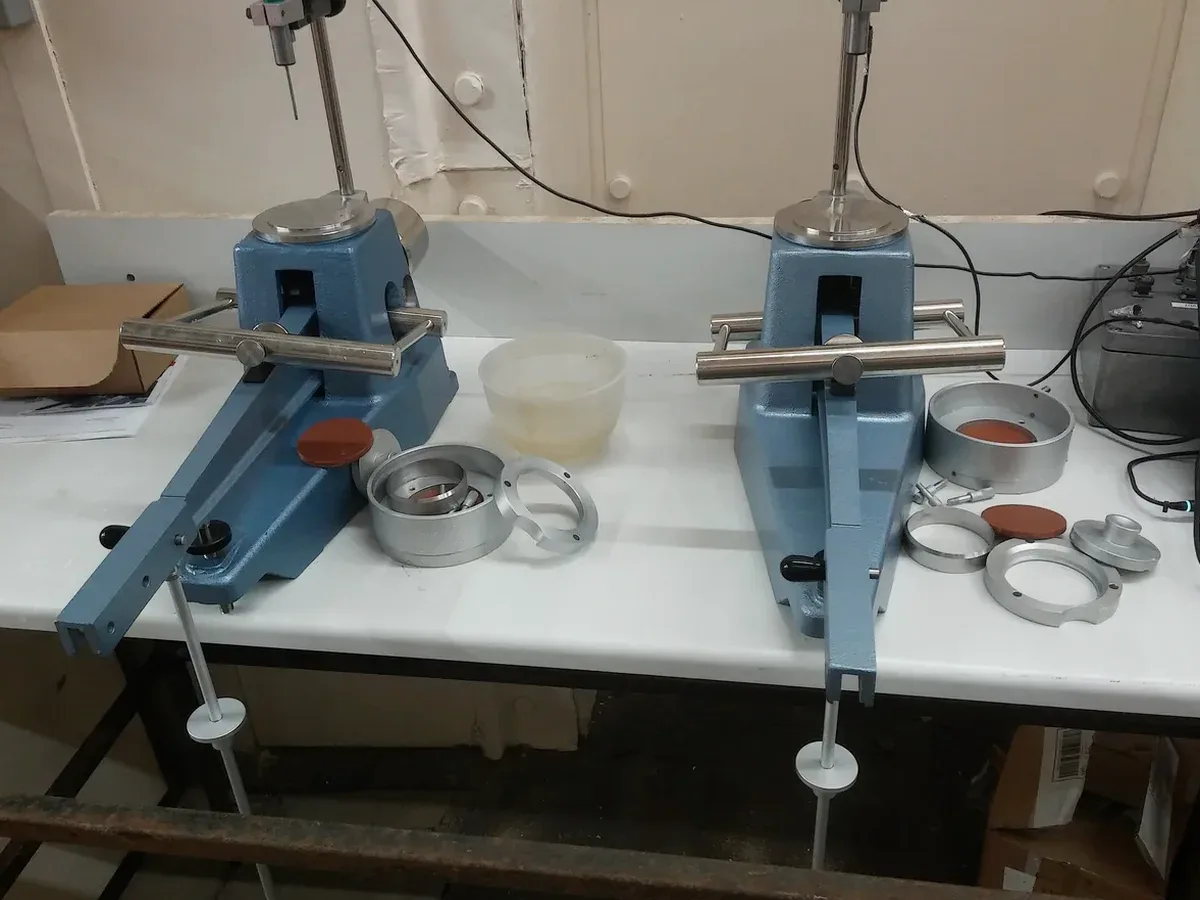
Liquid Limit (LL)Moisture content at 25 blows (Casagrande cup)
Plastic Limit (PL)Moisture content at 3.2 mm thread crumbling
Plasticity Index (PI)PI = LL - PL
USCS Classification BasisA-line chart (Casagrande plasticity chart)
Sample PreparationWet or dry preparation per Method A or B
Typical Stockton LL Range (Clay)35–70 (varies by organic content)
ReportingLL, PL, PI, and USCS group symbol

Frequently asked questions

What do the Atterberg limits test results actually tell a foundation designer?

The liquid limit and plastic limit define the moisture range over which a fine-grained soil behaves plastically. When the plasticity index is high—above 20 or 25, as we frequently see in the basin clays south of the Stockton Deep Water Channel—the soil will undergo significant volume change with seasonal wetting and drying, which directly governs the required depth of footings and whether a capillary break or moisture barrier is warranted under the slab. The results also feed into empirical correlations for undrained shear strength and preconsolidation pressure used in settlement analysis.

How much does Atterberg limits testing cost in Stockton?

For a single multi-point determination covering liquid limit, plastic limit, and plasticity index on one sample, the cost typically runs between US$60 and US$100 depending on sample condition and whether the material requires special drying or pretreatment. Most of our projects bundle several samples together, and we provide a discounted rate for combined classification suites that include washed sieve analysis with the Atterberg package.

Do you need undisturbed samples for Atterberg limits, or are disturbed bag samples acceptable?

Disturbed bag samples are perfectly acceptable for Atterberg limits testing, and that's actually the standard approach on most Stockton projects. The test is performed on the fraction passing the #40 sieve, so in-situ structure is irrelevant. We do need to know the natural moisture content separately if you want the liquidity index calculated, which requires a careful sealed-sample approach, but the plasticity parameters themselves are determined from remolded material and are not sensitive to disturbance.

How long does it take to get Atterberg limits results back from the lab?

Standard turnaround for a single sample is 2 to 3 business days. If the soil has high organic content and requires oven-drying at 60°C rather than 110°C to avoid burning off organic matter, or if multiple replicate determinations are needed because the first set falls near the A-line boundary, we allow an extra day. Rush service with next-day reporting is available for active construction projects where grading has encountered unexpected material and the contractor needs a quick classification to adjust compaction specifications.

Location and service area

We serve projects in Stockton and surrounding areas. More info.

View larger map