GEOTECHNICALENGINEERING1
STOCKTON
HomeRoadwayRigid pavement design

Rigid Pavement Design in Stockton: Concrete Performance for the Central Valley

Geotechnical engineering with regional judgment.

LEARN MORE

The San Joaquin Valley floor presents a unique challenge for concrete pavements. Stockton’s location at the confluence of deep alluvial deposits and a historically high water table—often within five feet of the surface in the Boggs Tract area—means rigid pavement design here is less about the concrete mix and more about what lies beneath it. Expansive clay layers, common in soils mapped as Stockton series, undergo significant volume change between the dry summer and wet winter months. Without a subgrade engineered for this cyclic movement, even a nine-inch doweled slab will curl, crack, and fault at the joints within a few seasons. Our approach in Stockton integrates a detailed geotechnical investigation to isolate these active clay lenses, allowing the pavement structural section to be calibrated precisely to the local modulus of subgrade reaction. We apply the 1993 AASHTO Design Guide for rigid pavements, layering in local climate data and the heavy truck traffic profiles typical of Highway 99 and the Port of Stockton logistics corridors. For projects where the subgrade cannot be economically stabilized with cement or lime, the design shifts to a thicker slab or an asphalt-treated permeable base to control pumping at the joints. This is not a copy-paste design from the Caltrans standard plans; it is a site-specific response to Stockton’s basin hydrology and soil chemistry.

In Stockton’s expansive clay basins, a rigid pavement’s service life is determined by the uniformity of the treated subgrade—not just the slab thickness.

Our service areas

How we work

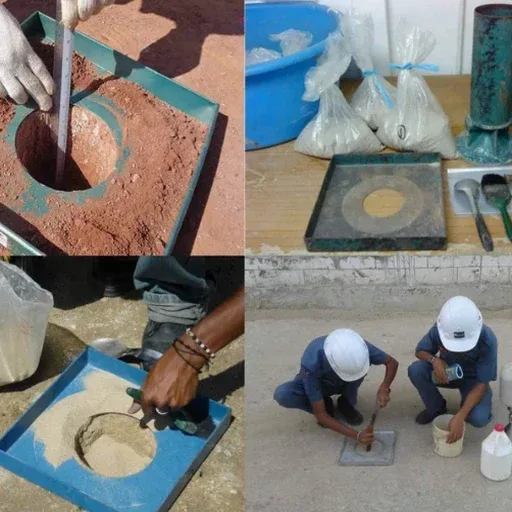
A rigid pavement in north Stockton’s Spanos Park area, where the near-surface soils are predominantly young alluvial silts, behaves fundamentally differently than one placed three miles south near the Deep Water Ship Channel, where the profile shifts to loose sands and organic silts. The distinction matters because the modulus of subgrade reaction, or k-value, can range from 100 pci on soft, saturated clay to over 400 pci on a well-compacted, cement-treated base. We quantify this parameter through a combination of field plate load testing and laboratory resilient modulus on Shelby tube samples. The design process then determines the required slab thickness using the Westergaard edge-loading equations, ensuring that the tensile stress at the slab corner does not exceed the concrete’s flexural strength after 28 days. For industrial yards at the Port of Stockton, we also specify the joint layout and load transfer efficiency—typically requiring 1.25-inch diameter smooth dowels at 12-inch centers for slabs exceeding eight inches. The concrete mix design itself is adjusted for the Valley’s summer placement conditions, often incorporating a water-reducing admixture to maintain a 1.5-inch slump without adding excess water, preserving the 4,000 psi flexural strength target. When a project extends into areas with known sulfate-rich groundwater, we switch to a Type V cement and specify a minimum cover of 3 inches over the reinforcement. This level of detail, grounded in ASTM C78 and ASTM C143 testing, prevents the premature deterioration that has plagued older concrete roadways in western Stockton’s industrial zones, where sulfate attack and alkali-silica reaction were not originally accounted for.
Rigid Pavement Design in Stockton: Concrete Performance for the Central Valley
Technical reference — Stockton

Local geotechnical context

A 200,000-square-foot distribution center off Arch Road was paved with a rigid pavement designed solely from a desk study. The geotech report assumed a uniform k-value of 200 pci across the entire site. Eighteen months after placement, the eastern third of the slab showed extensive corner breaks and transverse cracking at irregular intervals. Core samples revealed that the subgrade in that section was a pocket of high-plasticity clay with a liquid limit above 60, which had expanded during the winter rains and lost bearing capacity. The repair required full-depth patching of 15% of the slab area and an under-slab grouting program that cost the owner more than the original pavement contract. The scenario is not unique to Stockton—it is a predictable outcome when the subgrade investigation skips the variability inherent in the Riverbank Formation deposits. We insist on a grid of dynamic cone penetrometer tests spaced at 50-foot centers in the building pad before locking in the pavement design. When weak pockets are found, we prescribe a localized lime treatment to a depth of 18 inches, raising the k-value and breaking the shrink-swell cycle. On sites with a groundwater table above the subgrade level, we add a capillary break and edge drains to prevent moisture migration into the treated layer, a detail often omitted in standard designs but critical for Stockton’s low-lying industrial parks.

Need a geotechnical assessment?

Reply within 24h.

Email: info@geotechnicalengineering1.com

Regulatory framework

AASHTO 1993 Guide for Design of Pavement Structures, ASTM C78 / C78M: Flexural Strength of Concrete, ASTM D1196 / D1195: Plate Load Test for k-value, Caltrans Highway Design Manual, Chapter 620: Rigid Pavement, ASTM D2487: Unified Soil Classification System, ACI 360R-10: Guide to Design of Slabs-on-Ground

Technical parameters

ParameterTypical value
Design k-value (pci)100 – 450 (site-specific via PLT)
Slab thickness range (in)6 – 12 (per AASHTO 1993)
Concrete flexural strength (psi)550 – 650 at 28 days (ASTM C78)
Dowel diameter for load transfer (in)1.0 – 1.5 (smooth, ASTM A615)
Joint spacing (ft)12 – 15 (unreinforced) / 30 – 60 (JRCP)
Base type beneath slabCement-treated (CTB) or asphalt-treated (ATPB)
Typical service life target (years)30 – 40 for major arterials

Frequently asked questions

What is the minimum slab thickness for a rigid pavement design on expansive Stockton clay?

For a subgrade with a PI above 35 and a low k-value (below 150 pci), a minimum of 7 inches is typical for light industrial traffic, but we generally specify 8 to 9 inches after stabilization to account for the moisture sensitivity of the Stockton series soils. The final thickness is determined by the AASHTO 1993 design equation using the specific truck traffic mix and the 28-day concrete flexural strength.

How do you address the high groundwater table in Stockton under a rigid pavement?

When the groundwater table is within 3 feet of the subgrade surface, we incorporate a permeable drainage layer beneath the slab, typically an open-graded aggregate with edge drains, to prevent pore pressure buildup under traffic loading. This detail is essential in areas like Boggs Tract and around Smith Canal to avoid pumping of fine material at the joints.

What is the approximate cost range for a rigid pavement design package in Stockton?

A full design package—including subgrade investigation, k-value determination, mix design validation, and jointing plan—runs from US$1,690 to US$5,420 depending on the site area and the number of plate load test locations required. The scope includes a design report sealed by a California-licensed civil engineer.

Can you design a rigid pavement for container handling areas at the Port of Stockton?

Yes. For port facilities with loaded reach stackers and top picks imposing wheel loads exceeding 100 kips, we use a Westergaard-based finite element analysis to model the slab response. The design typically results in a 10- to 12-inch slab with a high-strength, low water-cement ratio concrete and closely spaced dowels at the construction joints.

Location and service area

We serve projects in Stockton and surrounding areas. More info.

View larger map