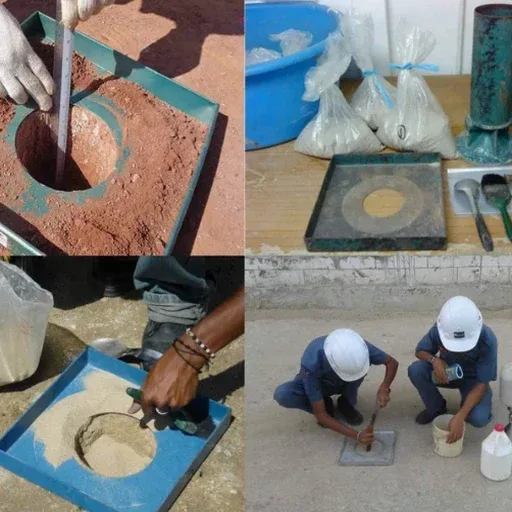
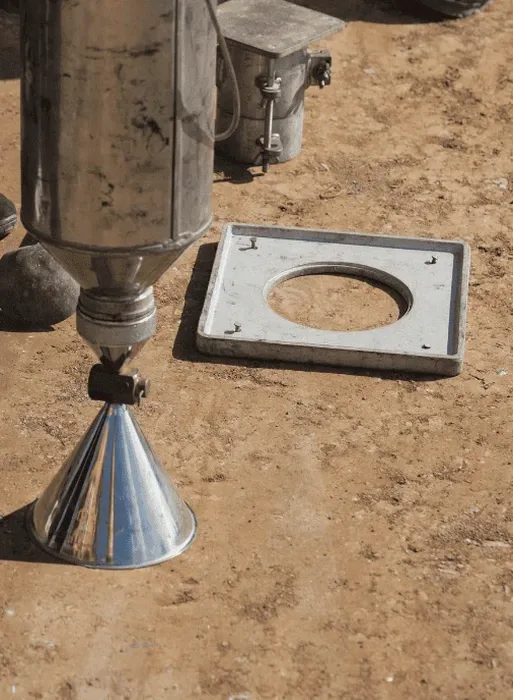
The San Joaquin Valley floor beneath Stockton presents a working platform of young alluvial clays and silts, shaped by centuries of river meandering. What looks like solid ground can hide lenses of loose sand or pockets of organic material that compact unpredictably under load. When a contractor places fill for a warehouse pad off Arch Road or backfills a trench along the Calaveras River, the question is never whether the soil was compacted, but whether the density achieved actually meets the project specification. The sand cone method provides that answer directly. We follow ASTM D1556 procedures to measure in-place density and compare it against the maximum dry density from the lab's Proctor curve. In Stockton's variable subsurface—where you can go from stiff clay to silty sand in a single lift—on-the-spot verification keeps earthwork moving without waiting for remote lab turnaround.
Compaction acceptance in the Central Valley is never about the roller pass count—it’s about the measured density against the lab standard, and the sand cone gives you that number right on the lift.