GEOTECHNICALENGINEERING1
STOCKTON
HomeInvestigationCPT (Cone Penetration Test)

CPT Testing in Stockton: Fast Stratigraphy for the Central Valley

Geotechnical engineering with regional judgment.

LEARN MORE

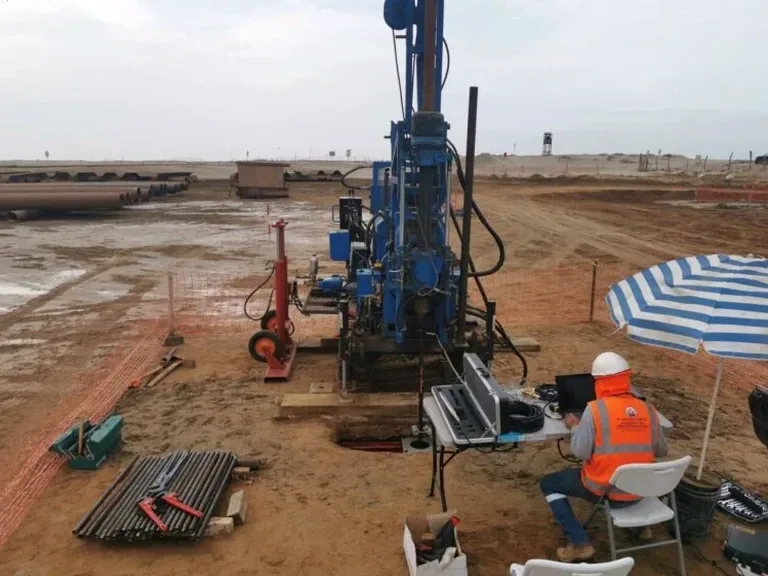
The biggest mistake we see on Stockton construction sites is relying solely on SPT data without verifying it against a continuous profile. The San Joaquin Delta's complex stratigraphy—organic peat lenses, soft clays, and loose silts layered within feet of each other—makes standard split-spoon sampling a gamble. Miss a thin, compressible layer at 18 feet, and you are looking at differential settlement that cracks slabs and misaligns equipment within the first two years. A Cone Penetration Test eliminates that blind spot, recording tip resistance, sleeve friction, and pore pressure every centimeter from the surface down to refusal. When we deploy the rig near the Port of Stockton or out toward Eight Mile Road, the continuous log picks up transitions that a 5-foot SPT interval simply cannot resolve. Combining CPT data with SPT drilling gives us both a high-resolution profile and physical samples for index testing, which is the standard of care for projects requiring Caltrans or City of Stockton Building Division review.

Continuous CPT logs catch the thin peat seams and loose silts that standard SPT intervals miss across the Stockton Delta.
Our service areas

How we work

Stockton sits at just 13 feet above sea level, surrounded by reclaimed Delta islands where groundwater is often within 4 to 6 feet of the surface. This shallow water table forces a specific approach to subsurface investigation: any drilling method that disturbs the soil risks collapsing the borehole or washing out fines, skewing blow counts. The CPT rig pushes a 15 cm² cone at a constant 2 cm/s rate, measuring cone tip resistance (qc), sleeve friction (fs), and dynamic pore pressure (u2) in situ without removing any material. That no-drill-cuttings advantage matters logistically in Stockton—contractors avoid dewatering permits, disposal of contaminated spoils from former industrial parcels along the Channel, and the downtime that comes with hollow-stem auger refusal in dense sand. We often pair the CPT with a seismic refraction survey when the client needs shear-wave velocity (Vs) profiles for seismic site class determination under ASCE 7-22 Chapter 20, or with liquefaction triggering analysis using the Robertson (2009) and Boulanger & Idriss (2014) CPT-based methods for sites mapped within the liquefaction susceptibility zones of San Joaquin County.
CPT Testing in Stockton: Fast Stratigraphy for the Central Valley
Technical reference — Stockton

Local geotechnical context

The most expensive surprise we have diagnosed with CPT is a 3-foot-thick peat seam at 22 feet depth beneath a proposed warehouse slab near Arch Road. The SPT log showed N-values of 12 to 15 in the surrounding silty sand, and the contractor assumed competent bearing. The CPT pore pressure trace spiked from hydrostatic to over 300 kPa within that seam and took 45 minutes to dissipate—classic behavior of highly compressible, normally consolidated organic material. Without that cone data, the slab would have been placed on a ticking settlement clock. Stockton's historic marsh deposits and channel-fill sequences hide these hazards throughout the city, especially east of I-5 where the Calaveras River floodplain transitions into the deeper basin. A CPT rig can push through 75 feet of this stratigraphy in under two hours, giving the geotechnical engineer a pore-pressure-corrected profile that reveals exactly where ground improvement—such as stone columns or surcharge with wick drains—must be targeted before foundation construction begins.

Need a geotechnical assessment?

Reply within 24h.

Email: info@geotechnicalengineering1.com

Regulatory framework

ASTM D5778 – Standard Test Method for Electronic Friction Cone and Piezocone Penetration Testing of Soils, ASTM D2487 – Standard Practice for Classification of Soils for Engineering Purposes (Unified Soil Classification System), ASCE 7-22 Chapter 20 – Site Classification Procedure for Seismic Design, Caltrans Geotechnical Manual – CPT interpretation for transportation projects, IBC 2021 Section 1803 – Geotechnical Investigations (adopted by City of Stockton)

Technical parameters

ParameterTypical value
Cone typePiezocone (CPTu), 15 cm² cross-sectional area, 60° apex angle
Measured parametersTip resistance (qc), sleeve friction (fs), pore pressure (u2), friction ratio (Rf)
Penetration rate2 cm/s ± 10%, per ASTM D5778
Typical depth range50 to 80 ft in Stockton basin soils; refusal criteria at qc > 400 tsf
Data intervalContinuous (1 cm sampling), reduced to 5 cm for engineering reports
Soil classificationRobertson (1986, 1990) SBT charts updated with normalized SBTn (Robertson, 2016)
Pore pressure dissipationt50 recorded at clay layers for consolidation coefficient (ch) estimate

Frequently asked questions

How much does a CPT sounding cost in Stockton?

A standard CPTu sounding to 50–80 feet depth in Stockton typically ranges from US$170 to US$270 per sounding, depending on depth, access constraints, and whether pore pressure dissipation tests are required. Mobilization is a separate line item and varies with distance from our nearest dispatch point. For a fixed-price proposal tied to your project address, contact us with the planned number of soundings and we will turn around a quote within one business day.

Can CPT replace SPT borings entirely?

Not entirely, but CPT reduces the number of SPT borings needed. CPT provides continuous stratigraphy and soil behavior type, but you still need physical samples for laboratory index testing: grain size distribution, Atterberg limits, and moisture content. The most efficient approach we design for Stockton projects is a hybrid program—CPT soundings spaced at 50 to 100 ft to map the profile, with targeted SPT borings at 200 ft spacing to recover samples in each major soil unit.

How long does a CPT test take on a Stockton site?

A single CPT sounding to 70 feet takes roughly 45 to 90 minutes of push time, depending on soil resistance. With setup and breakdown, expect about 2 hours per location. Pore pressure dissipation tests in clay layers add 20 to 60 minutes each. A typical day can complete 4 to 6 soundings on an open site with good truck access. Tighter urban lots near downtown Stockton may reduce that to 3 soundings due to rig maneuvering time.

Location and service area

We serve projects in Stockton and surrounding areas.

View larger map