GEOTECHNICALENGINEERING1
STOCKTON

Geotechnical Engineering in Stockton

Geotechnical engineering with regional judgment.

LEARN MORE

In Stockton, we repeatedly encounter the same scenario: a routine site investigation that suddenly hits an 8-foot layer of spongy peat at 15 feet, right where the footing load concentrates. The San Joaquin Delta left a complex stratigraphy of Holocene alluvium, organic silts, and loose sands that makes a generic bearing capacity assumption flat-out dangerous. Our soil mechanics study maps these transitions precisely, distinguishing stable Pleistocene terrace deposits near the Calaveras River from the highly compressible basin clays south of the Crosstown Freeway. When we interpret a boring log, we’re not just looking at blow counts—we’re correlating undrained shear strength with the depositional environment that created the soil. For deep excavations in the downtown area, this level of detail becomes critical, and we often specify a deep excavation monitoring program to track lateral movements in real time against the predicted model derived from our lab data.

A soil mechanics study in Stockton must resolve the deltaic stratigraphy down to the Pleistocene to prevent differential settlement between adjacent structures.
Geotechnical Engineering in Stockton
Technical reference — Stockton

Our service areas

Local geology

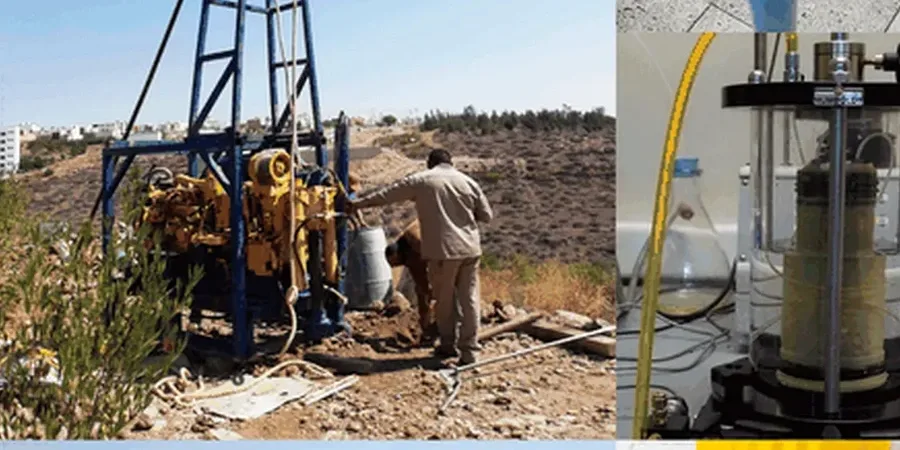
The contrast between a site near the University of the Pacific, which sits on relatively stiff older alluvium, and a warehouse expansion out by the Port of Stockton, built on thick recent bay mud, illustrates why we never reuse a geotechnical profile across neighborhoods. The campus ground might yield a net allowable bearing pressure over 3,000 psf for shallow footings, while the port location demands deep piles driven through 40 feet of soft clay before finding competent sand. Our laboratory program quantifies this difference through consolidated-undrained triaxial tests that measure effective stress parameters, combined with consolidation tests that define the compression index and coefficient of consolidation for each compressible stratum. The resulting settlement analysis—both immediate and long-term—directly informs the foundation design, and when the numbers show excessive total settlement, we evaluate alternatives like stone columns to reduce the load path through the weakest layers.

Regulatory framework

ASTM D1586 Standard Test Method for SPT, ASTM D2487 Unified Soil Classification System, ASCE 7 Minimum Design Loads for Buildings, IBC Chapter 18 Soils and Foundations

Need a geotechnical assessment?

Reply within 24h.

Email: info@geotechnicalengineering1.com

Why choose us

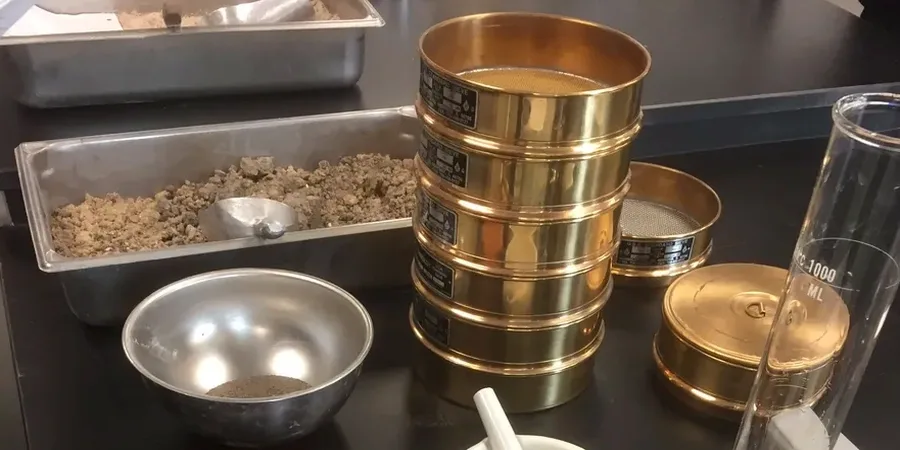
The International Building Code, as adopted by Stockton, mandates a site-specific geotechnical investigation for any structure assigned to Seismic Design Category D, which covers the majority of the city due to the soft soil amplification effects mapped in the USGS seismic hazard model. The risk we focus on is not just bearing failure—it’s post-liquefaction settlement and lateral spreading along the levees of the San Joaquin River. ASCE 7 requires us to evaluate the factor of safety against liquefaction at multiple depths using the NCEER method, which we compute from SPT data and fines content measured through grain size analysis of the saturated sands. A low factor of safety triggers a mitigation analysis that can involve densification or deep foundation support. Ignoring this step invites a differential settlement of 4 to 8 inches across the building footprint after a design-level earthquake, rendering the structure unserviceable.

Technical parameters

ParameterTypical value
Undrained Shear Strength (Su) - Soft Clay200 - 500 psf
Compression Index (Cc) - Peat/Organic Silt1.5 - 3.5
Standard Penetration Resistance (N60) - Alluvium4 - 18 blows/ft
Overconsolidation Ratio (OCR) - Upper Clays1.0 - 2.5
Depth to Pleistocene Stiff Soils25 - 65 ft
Groundwater Table Depth3 - 8 ft
Liquefaction Potential Index (LPI)Moderate to High (Fines <15%)

Frequently asked questions

What does a soil mechanics study cost for a typical commercial lot in Stockton?

For a standard commercial parcel under 1 acre, a complete soil mechanics study including borings, lab testing, and engineering report typically runs between US$2,700 and US$5,460. The spread depends on depth to refusal, number of samples requiring triaxial or consolidation tests, and whether groundwater monitoring wells are required by the city’s building department.

How deep do you need to drill to evaluate liquefaction risk in Stockton?

We typically extend borings to at least 50 feet below grade or until we penetrate a non-liquefiable bearing stratum, whichever is deeper. The critical zone for liquefaction in Stockton is usually the upper 35 feet, where the loose saturated sands of the Modesto Formation are most susceptible to cyclic mobility during a seismic event.

Can you design a foundation on the peat layers without removing them?

Direct bearing on peat is not recommended. Our standard approach is to bypass the peat with driven piles or to excavate and replace it with engineered fill if the layer is thin. We analyze both options, calculating negative skin friction on piles from consolidating peat and comparing the cost against a rigid mat foundation with a thick structural slab to bridge soft spots.

What laboratory tests are mandatory for a Stockton office building foundation?

At minimum, we run moisture content, Atterberg limits, unconfined compression on clays, and direct shear on sands. For any structure over two stories, we add one-dimensional consolidation tests and triaxial compression to define the effective stress envelope. The specific suite is dictated by the variability we observe in the field—if we hit organic silt, we immediately add loss-on-ignition testing to quantify organic content.

How long does the field and lab work take before we get the report?

Field drilling and sampling usually take two to three days for a standard site. Laboratory testing runs concurrently and extends to about two weeks, with consolidation tests dictating the critical path because they require staged loading over several days. The final geotechnical report is delivered within three weeks of completing the fieldwork.

Location and service area

We serve projects in Stockton and surrounding areas.

View larger map